Business summary
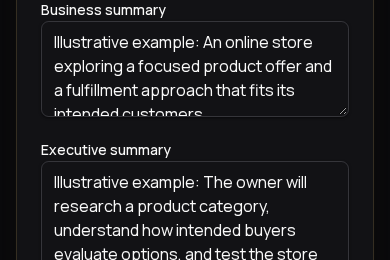
Illustrative example: An online store exploring a focused product offer and a fulfillment approach that fits its intended customers.
DA GIFT FOUNDATION · BUSINESS PLANNING
An e-commerce plan helps connect a product idea with the customer, fulfillment choices, and costs that still need investigation. A written next-action sequence can keep product selection, supplier checks, store setup, and customer feedback from becoming disconnected tasks.
The plan and interface below show illustrative sample content. Replace it with details and assumptions that fit your business.
A USEFUL FIRST DRAFT
This template uses the fields in DaGiftFoundation’s current editor. Each starting answer is editable before you save it to your workspace.
Illustrative example: An online store exploring a focused product offer and a fulfillment approach that fits its intended customers.
Illustrative example: The owner will research a product category, understand how intended buyers evaluate options, and test the store and fulfillment assumptions before expanding the offer. No sales or margin figures are supplied.
Illustrative example: Online shoppers with a defined use case or preference that the proposed product selection intends to address.
Illustrative example: Shoppers may have difficulty finding an offer that fits their needs, expectations, and preferred purchase experience.
Illustrative example: Present a focused product offer with clear information and a fulfillment process the owner can verify and support.
Illustrative example: Direct-to-Consumer (DTC) Product Sales. This is an illustrative revenue category, not a sales estimate or validated product opportunity.
Illustrative example: Compare supplier and fulfillment requirements, then prepare a small store test with clear customer questions.
A PRACTICAL PLANNING GUIDE
An e-commerce or dropshipping business plan template helps organize product, customer, and fulfillment choices before a store relies on them. Describe the product category you want to explore and the type of shopper you expect to serve. Research product quality, supplier terms, shipping expectations, returns, support needs, and store costs for your own situation; the sample does not supply verified vendors, demand, or margins. A dropshipping business plan should make dependencies visible, especially when delivery and product handling are provided by another party. Use the summary and executive summary to state what you intend to test, what remains unknown, and how you will decide whether the idea deserves another step.
The Customer Problem field can explain what a buyer is trying to accomplish and where current options may not fit. In Solution, outline the product offer and buying experience you plan to investigate, including what information shoppers need before ordering. Target Customer helps narrow product research and customer questions. For Revenue Model, the sample uses Direct-to-Consumer (DTC) Product Sales as an illustrative category; it is not evidence that a particular item will sell or that a particular margin is achievable. Next Milestones can include comparing supplier terms, understanding shipping and return responsibilities, preparing product information, and testing the store with a small group of intended buyers.
The editable e-commerce business plan covers a business summary, executive summary, target customer, Customer Problem, Solution, Revenue Model, and Next Milestones. Once saved, the workspace lets you add goals, break them into next actions, record optional due dates or blockers, and review progress later. This gives a dropshipping startup plan or online store business plan a practical workflow for tracking research and follow-up without inventing store features, integrations, or performance results. Use the template to keep product selection, fulfillment questions, and customer learning connected. Replace all illustrative content with verified supplier information, your actual offer, and assumptions you are prepared to examine before using the plan to guide commitments.
Make this e-commerce / dropshipping plan your own in the editor.
COMMON STARTING QUESTIONS
Describe the product offer, target customer, customer problem, solution, revenue model, and next milestone. Research suppliers, fulfillment, shipping, returns, store costs, and customer support for your own business.
A dropshipping plan should make supplier, product handling, delivery, returns, and customer-support responsibilities explicit so the owner can verify how the arrangement would work.
It uses Direct-to-Consumer (DTC) Product Sales as an illustrative category. It does not estimate sales or confirm that a specific product is viable.
You could review supplier terms, clarify product information, test the store experience with intended buyers, and write down what feedback would change your next decision.